

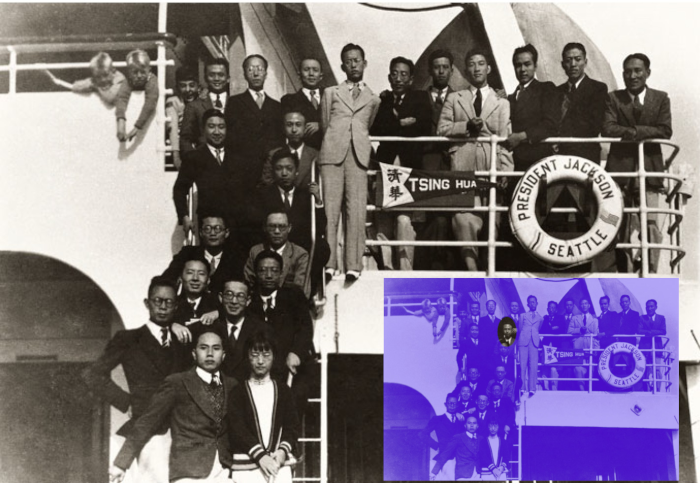
Qian Xuesen and other Boxer scholars aboard President Jackson steamship en route to America (Shanghai, August 1935 : Quian Xuesen highlighted in the bottom right blue square)
Qian Xuesen : A Star Is Born (1911 – 1945)
“At age 36, he was already an undisputed genius whose work gave tremendous impetus to advances in high-speed aerodynamics and jet propulsion.”
Theodore von Kármán ([8], 1967) on Qian Xuesen, a doctoral student under his supervision from 1936 to 1939

CONTENT
Qian Xuesen : A Little-Known Giant of Space Exploration
Introduction to the Article
2. Qian Xuesen’s Youth and Education (1911–1934)
Family Background
Higher Education in China
3. The Boxer Rebellion and the “Boxer Rebellion Scholarship”l
The Events
The Boxer Rebellion Scholarship
Further Reading
4. Early Years in the United States (1934–1936)
Success in China
Success in the United States
5. Daniel Guggenheim Fund for the Promotion of Aeronautics
An Industry in Crisis
Founding of the Guggenheim Schools of Aeronautics
GALCIT and von Kármán
Arrival at Caltech
The Suicide Squad (1936-1939)
General Arnold and the First Drone in History
Research fellow (1939)
China Recalls Qian Xuesen
Von Kármán’s Support
8. Return to Favor (1940 – 1943)
A Detour into Structural Analysis
Return via Wind Tunnels
Necessity Is the Mother of Invention (December 1941)
A Dreaded Professor (1943)
9. The Birth of JPL (1943 – 1944)
Alarming News from Europe (1943)
First Steps Toward JPL (1943)
Things Get Serious (1944)
At the Head of the “Research Analysis” Section (1944)
10. First Launches (1944 – 1945)
Private A
Private F
Further Developments
11.The Army Air Force Scientific Advisory Group (1945)
Von Kármán Leaves Caltech (1944)
Qian Xuesen Joins Him in Washington
12. Operation LUSTY (Germany, Spring-Summer 1945)
Préparations
Organization
Meeting with Wernher von Braun
Rudolph Herman’s Tribute to Qian Xuesen
Discovery of the LFA
Meeting with Ludwig Prandtl
Back to the United States

1. Introduction
1.1 Qian Xuesen : A Little-Known Giant of Space Exploration
When considering the list of major scientists who made the space age possible in the 20th century, certain names immediately come to mind. Werner von Braun is likely among the top five (at least among the general public in the West), and Sergei Korolev, Robert Goddard, or Theodore von Kármán might be as well.
Others, less well-known outside the scientific community, have not been completely forgotten either: on its page dedicated to these pioneers, for example, the Smithsonian Institution lists names as historic as Konstantin Tsiolkovsky (Russia), Hermann Oberth (Germany), and even that of a Frenchman whom virtually no one in his own country remembers anymore (Robert Esnault-Pelterie) —except for certain specialists and/or members of learned societies.
But curiously, one giant of the field was not included on this list: the Chinese scientist Qian Xuesen (also known as Hsue-shen Tsien).
To be fair, this scientist’s story has not been forgotten, especially in China, where he is a national hero, but also in the United States: for example, the magazine *Aviation Week* published an issue featuring him on the cover in 2008, less than two years before his death [3], and articles about him are numerous and easy to find online. Many are even highly complimentary.


1.2 Introduction to the Article
The Origin of the Project
Qian Xuesen’s modest fame outside the two countries mentioned above and among his peers is nonetheless surprising.
After all, we are talking about an extraordinary scientist whose life spans the entire 20th century (born in 1911 and died in 2009) and was a witness —often an active one— to most of the tragedies of that period: from the Chinese Civil War between the Nationalists and the Communists, to the bloody postwar episodes (the Great Leap Forward, the Cultural Revolution, Tiananmen Square…), including World War II and the McCarthyism craze in the United States.
We have therefore decided to dedicate the second article in our Science & History series to him (for more information on this section, see the introductory article about it).
Sources
To reconstruct his life story, we relied on one major source: the biography published in 1995 by historian Iris Chang [1], which is likely the most comprehensive book on the life and work of Qian Xuesen. Consequently, the account of his life that we present here will more or less follow the chronology of this reference. By default, the information we present here is drawn from this biography.
We will, however, supplement it with other sources, the most notable of which are:
- A more recent biography of Chinese origin [2] that provides additional details to the previous one, particularly regarding events after 1995, but whose slightly hagiographic nature requires reading with a degree of skepticism.
- Von Karman’s autobiography [8]
- The memoirs of Frank J. Malina ([12] [13] [15]): a very important figure in the history of rocketry in the United States in general, and in the founding of JPL (NASA Jet Propulsion Laboratory) in particular, as well as one of Qian Xuesen’s closest American friends.
The Organization of the Articles
Originally, we had planned to devote just a single article to this story. The richness of the subject ultimately led us to write four parts covering the first part of his life:
- A Star Is Born: from his birth to the end of World War II (this article)
- A Destiny Takes Shape: 1945–1947
- The Irresistible Rise: 1947–1950
- An American Tragedy: from 1950 until his return to China in 1955
These articles will be kept deliberately short to ensure readability. It will therefore be necessary at times to omit certain details that are not strictly necessary to the narrative.
Similarly, it is possible that some important details may have escaped our notice despite the numerous sources consulted, given the complexity of the story and its chronological scope.
In either case, we remain available to readers for any questions, comments, or suggestions on this subject.
The second part of Qian Xuesen’s life, which he spent in China, will be discussed later.
2. Qian Xuesen’s Youth and Education (1911–1934)
2.1 Family Background
Qian Xuesen was, from the very beginning, an extraordinary figure. He was born into a family whose lineage can be traced back to the 9th century A.D.
As the 33rd direct descendant of Qian Liu (852–932), the fifth ruler of the Kingdom of Wuye, he was born on December 11, 1911, in Hangzhou (Zhejiang, in eastern China) in the family home that had been passed down from generation to generation [2].
His parents’ relatively affluent social status, their high expectations, and his precocious talent opened the doors to the best Chinese schools of the time for him. During his youth, he was thus able to receive a highly advanced and selective early education, which undoubtedly contributed to his later success in China and the United States.
2.2 Higher Education in China
In the fall of 1929, he enrolled in the railway department of the School of Mechanical Engineering at Jiaotong University (Shanghai), one of the most renowned institutions of the time. Although he was forced to interrupt his studies for a year to recover from typhoid fever, and despite the political chaos of that time, he graduated at the top of his class in 1934 [1] [4].
The climate of war and the corruption prevailing in China upon his graduation, combined with his growing interest in aviation, led him to seek opportunities abroad. To that end, he entered a competitive selection process at Tsinghua University (Beijing) to obtain a scholarship to study in the United States under the Boxer Rebellion Scholarship program.
The origins of this program deserve some attention, so let’s take a brief look back.


3. The Boxer Rebellion and the “Boxer Rebellion Scholarship”
3.1 The Events
In 1899, an uprising against the foreign powers present in China (mostly European nations, but also the United States, Russia, and Japan) broke out in the north of the country. It would later become known as the Boxer Rebellion.
This war —the origins and developments of which would take too long to describe here— involved mutual massacres and bloody repressions, and ended in 1901 with the crushing of the revolt and the imposition of very heavy fines on China.
China’s defeat at the end of the Boxer Rebellion sounded the death knell for the last Chinese imperial dynasty (the Qing), which collapsed in 1911 to make way for the Republic of China.
3.2 The Boxer Rebellion Scholarship
The United States, which was among the recipients of the fines imposed on China, discovered that China had overpaid; in 1909, President Roosevelt decided to return the excess funds in the form of a program to host Chinese students: the Boxer Rebellion Scholarship (this program ended in 1937, the year of Japan’s invasion of China).
3.3 Further Reading
To learn more about this war, interested readers may start, for example, by reading the Wikipedia articles in French and English. One of the best-known episodes is the Siege of the Legations in Beijing (June 20–August 19, 1900), depicted in Hollywood style in the film *55 Days at Peking*.
4. Early Years in the United States (1934–1936)
4.1 Success in China
As the culmination of his brilliant academic career up to that point, Quien Xuesen, to his great relief, passed the highly selective entrance exam (only the four students with the highest grades in science and mathematics from each university were eligible to take the exam; a total of 25 spots were available, with additional requirements regarding exam scores [2]). He was the only one admitted to the aerospace program.
After spending an entire year on (mandatory) visits to Chinese companies (of which there were very few, and there wasn’t much to see), and following the advice of his Chinese mentor —himself an MIT graduate— he arrived at the prestigious Boston university in early September 1935. Not without having constantly feared that the wars that had been relentlessly ravaging the country since the early 1930s would rob him of his American dream:
- the civil war between the Kuomintang and the Maoists, culminating in the Long March in October 1934
- a simmering foreign war with Japan since 1931, culminating in 1937 in a full-scale invasion launched from the puppet state of Manchukuo
4.2 Success in the United States
Just as he had done flawlessly in China, he earned his master’s degree in 1936 from the Department of Aeronautics at MIT.
Logic would have dictated that he pursue his PhD at the same university. However, for reasons of his own, this was not to be: he chose instead to join Caltech.
But before addressing this major new phase of his life, it is worth taking a brief detour to examine developments in aeronautics in the U.S. during the interwar period.
More specifically, to fully understand the context in which Qian Xuesen arrived at Caltech, let’s take a look at a private initiative of the kind that only Americans know how to carry out: the Daniel Guggenheim Fund for the Promotion of Aeronautics.


5. Daniel Guggenheim Fund for the Promotion of Aeronautics [5] [6]
5.1 An Industry in Crisis
In the years following the end of World War I, the American aviation industry entered a period of crisis.
Not only had the surplus of wartime aircraft dried up the market for new planes, but flying also posed numerous risks, which deterred public interest (there were countless accidents and fatalities).
However, there was no pool of qualified technicians and engineers capable of turning the situation around.
The Guggenheims therefore decided to devote a portion of their immense fortune to fostering the creation of schools and research centers across the country.
5.2 Founding of the Guggenheim Schools of Aeronautics
In the early 1920s, there were only five places in the U.S. where aeronautical engineering was taught: MIT, the University of Michigan, Caltech, the University of Washington, and Stanford. Only the first two offered degree programs in the field.
In 1925, the Guggenheim Foundation began its work by funding an aeronautical engineering school at New York University.
Over the next four years, the foundation awarded grants that made it possible to establish schools or research centers:
- at Stanford University,
- at the University of Michigan,
- at the Massachusetts Institute of Technology,
- at the University of Washington,
- at the Georgia School (later Institute) of Technology,
- Harvard University,
- Syracuse University, Northwestern University, the University of Akron…
- …and at Caltech, where the school was christened “GALCIT” (Guggenheim Aeronautical Laboratory at Caltech Institute of Technology).
5.3 GALCIT and von Kármán
The grant awarded in 1926 by the Guggenheim Foundation enabled Caltech to establish a graduate school and an aeronautical laboratory, built around a brand-new subsonic wind tunnel (10-foot wind tunnel). The building housing GALCIT was completed in 1928.
A pivotal figure in Qian Xuesen’s life would join GALCIT: Professor Theodore von Kármán.
Born in Hungary in 1881, educated at the University of Budapest, and a student of Ludwig Prandtl at the University of Göttingen, he notably served as Director of the Institute of Aeronautics at the University of Aachen (Germany) beginning in 1913.
He left that position in 1915 to serve in the Austro-Hungarian Army during World War I. After the war, and following a series of twists and turns, he managed to return to his post in Aachen.
In 1926, he was invited to Caltech to contribute his expertise to the design of the 10-foot wind tunnel. He returned there permanently in 1929, driven by the rise of Nazism, to take up a position as “research associate in aeronautics.”
And in 1930, he became the first director appointed to head GALCIT [7].
He, too, was a giant in the field, but he is better known. NATO would name a research center located in the suburbs of Brussels after him: the von Kármán Institute for Fluid Dynamics.
6. PhD (1936 – 1939)
6.1 Arrival at Caltech
It was this already famous figure that Qian Xuesen met in 1936 to explore the opportunities available to him at Caltech to continue his studies in the United States.
They hit it off immediately, and Qian Xuesen was delighted to be offered the opportunity to pursue his PhD under von Kármán’s supervision.
Neither man knew it yet, but this marked the beginning of a collaboration that would last nearly 15 years, accompanied by a deep friendship and great mutual respect.
Qian Xuesen was, in fact, the only one of his students to whom von Kármán devoted an entire chapter in his memoirs [8].
And when, 60 years later, having become one of the giants of his field, Qian Xuesen was asked to evaluate von Kármán’s scientific contributions, he politely declined the offer: “Von Kármán was my respected teacher. I had strong personal feelings for him, and I was afraid I could not evaluate him fairly. ” [2].
6.2 The Suicide Squad (1936-1939)
When Qian Xuesen arrived at Caltech, a cheerful little group of Caltech students —inspired by the work of the GTO (Goddard, Tsiolkovsky, Oberth), as well as that of Esnault-Pelterie [12] and other more recent research conducted on the Old Continent (including that of the Austrian Eugen Sänger), devoted itself —alongside their academic studies— to dangerous experiments in rocket design in a deserted valley on the outskirts of Pasadena: Arroyo Seco.
These activities had the support of von Kármán, though this was not initially the case for the entire Caltech faculty.
This group was officially designated in June 1937 as the GALCIT Rocket Research Project. This gave it access to Caltech’s resources (and the opportunity to damage some of them!).
The leader was a man named Frank J. Malina, who would quickly become very close to Qian Xuesen.
Shortly after his arrival at Caltech, Qian Xuesen joined the group, nicknamed the “Suicide Squad” on campus due to its highly unorthodox experimental methods. This completed the core of the Rocket Research Group (there were then 6 members [12]).
Sometime in 1938, the group was on the verge of disbanding (at times, only Malina and Qian Xuesen were still actively involved) when it caught the attention of the U.S. Army Air Corps (which would become the Army Air Force in 1941, and later the U.S. Air Force) through General Arnold.
6.3 General Arnold and the First Drone in History
The Kettering Bug
Arnold was no stranger to Caltech: he had maintained close ties with Robert Millikan, then Director of Caltech, for many years —specifically since World War I, a time when R. Millikan had not yet been honored with the Nobel Prize in Physics (1923).
Toward the end of the war, he and Millikan were working on a prototype unmanned aircraft, the Kettering Bug —named after its inventor, Charles Kettering— which was the very first drone model in military history.
If we look closely, this vehicle was, in fact, a stunning precursor to the future military drones whose use has recently become widespread in the conflicts in Ukraine and the Persian Gulf.
Its design also presented the engineers of the time with all the challenges inherent to this type of craft, such as navigating to the target.
At the time, GPS wasn’t even a concept: to guide the craft to its target, the designers devised a method of counting the number of revolutions of the piston engine needed to cover the distance to the target. Once that count was reached, the engine was to be shut off, causing the unmanned aircraft to plummet onto the enemy.
To learn much more about this astonishing and largely unknown aircraft, interested readers can refer to the comprehensive and well-researched article on the History Collection website.
Arnold Funds Caltech’s Research
Thanks to General Arnold’s support, Caltech received funding that allowed it to resume work on rocket propulsion the very next year. We will have many opportunities to discuss this visionary general again as this story unfolds.
Anecdote on this subject [1]: When approached at the same time, MIT (through its Director of the Aeronautics Department) stated, referring to rocket research, that it was more than happy to leave this “Buck Rogers-style job” to Caltech.
Very soon, the group of enthusiasts known as the Suicide Squad and their supporters would give birth to JPL. But let’s not get ahead of ourselves.
6.4 Research fellow (1939)
His work on the Rocket Research Project did not, however, interfere with Qian Xuesen’s preparation for his PhD. He successfully defended his dissertation on June 9, 1939.
In August of that same year, he published an article that would remain a standard reference in the field for many years, from which emerged what would become known as the Kármán–Tsien correction [9]. This formula, designed to account for compressibility in aircraft design when their speed approaches the speed of sound, “was almost universally used until the advent of computers” (A.M.O. Smith, one of the members of the “Suicide Squad” in reference [1]).
The introduction to this paper is, in fact, a fine illustration of the relationship between the two men, as depicted in I. Chang’s description [1] and in the posthumous biography published in China [2]: a Theodore von Kármán with brilliant insights, and a Qian Xuesen who, with deep respect for his mentor, gave substance and rationale to those insights.
In the opening lines of his publication, Qian Xuesen pays tribute to von Kármán, who “suggested to [him] during a recent discussion” the generalization of an earlier theory at the heart of this paper: the brilliant idea and its clinical analysis.
In late 1939, with his dissertation in hand, he became a “research fellow” at GALCIT. His early research continued the work he had done with the Suicide Squad: developing solid and liquid rocket propellants that would provide improved thrust for use in aviation. But this time, he had more substantial financial resources from the military.
These resources would only continue to grow from 1940 onward, due to the escalation of conflicts around the world.


7. 1940: A Pivotal Year
7.1 China Recalls Qian Xuesen
Having arrived in 1935 on the Boxer Rebellion Scholarship for a planned duration of three years, Qian Xuesen was already in his fifth year in the United States.
China, which was then waging a ruthless and unequal war against Japan, called him back to duty. Torn between his obligations as a Chinese citizen and his strong desire to remain in the United States to continue the exhilarating life that the country had offered him —and foreseeing the fantastic prospects that were beginning to open up for him— Qian Xuesen faced an enormous moral dilemma.
His friend Malina had perfectly captured this moral dilemma. A famous graffiti drawing in which he caricatures his group of comrades has survived: it shows a pensive Qian Xuesen wavering between China and the U.S.
7.2 Von Kármán’s Support
It was von Kármán who came to his rescue by pleading his case with the Chinese authorities. This would not be the last time he would have to use his moral authority to help Qian Xuesen weather the headwinds.
To that end, he argued that there were many ways to serve one’s country, and that Qian’s presence at Caltech was one of them—perhaps the best. He therefore suggested granting him one more year in the United States.
In the end, the Caltech administrators secured two additional years from the Chinese and American governments. It was a close call, but there would be worse ones to come.
Qian Xuesen, however, found himself forced to distance himself from the Suicide Squad. The group’s activities had in fact expanded to include classified matters which, as a non-U.S. citizen, were off-limits to him… at that time!
Meanwhile (until his return in late 1942), and at the request of the military, F. Malina and Caltech developed, among other things, the so-called JATO (Jet-Assisted Take-Off) boosters at the Arroyo Seco site. These were intended to be mounted on aircraft to shorten their takeoff run.
8. Return to Favor (1940 – 1943)
8.1 A Detour into Structural Analysis
Forced to work only on unclassified projects, Qian Xuesen temporarily turned his attention to structural analysis—a field in which he proved to be just as brilliant as he had been in every position he had held previously.
8.2 Return via Wind Tunnels
Meanwhile, thanks to von Kármán’s diplomatic skills, Caltech was once again awarded funding—this time from the Army Ordnance Department (the Army department responsible at the time for weapons and ammunition development).
8.3 Necessity Is the Mother of Invention (December 1941)
December 7, 1941: Pearl Harbor. America is in a state of shock, and in some places, panic. The country must devote all available resources to the war effort without neglecting any of them.
Von Kármán then intervened once again and pointed out that his laboratory had a first-rate aerodynamicist whose talents could be put to good use in this endeavor. He even personally vouched for Qian Xuesen’s loyalty. This enabled him to secure all the necessary clearances for Qian so that he could participate in Caltech’s classified activities.
In 1942, he was thus reunited with his friend Malina. He was then able to resume his work with him on rocket design research, right where the Suicide Squad had first begun.
8.4 A Dreaded Professor (1943)
Promotion
After four years as a “research assistant,” Qian Xuesen was offered a position as an assistant professor of aeronautics, which he accepted in late 1943. He had already been in the United States for nearly ten years (his residence visa had been renewed numerous times to allow him to stay).
Qian Xuesen then divided his time between teaching and research in aerodynamics and rocket propulsion. He worked on numerous classified contracts and, true to his reputation as a tireless worker, produced a steady stream of technical reports.
First Courses on Jet Propulsion
It was also in 1943, at the request of the Army Air Force, that von Kármán organized the first “graduate course” in the United States on jet propulsion. The first students were Air Force and Navy officers sent there to pursue their master’s degrees in aeronautics.
Qian Xuesen was assigned to teach the courses “Mathematical Principles in Engineering” and “Jet Propulsion.” Working tirelessly, he devoted himself to his students far beyond the scope of these two course series.
Nevertheless, like other professors involved in this program, Qian Xuesen did not always view this work favorably, as it distracted him from more important research activities.
Was it for this reason—or, one might say, because of Qian Xuesen’s uncompromising nature—that he would become the most feared professor at Caltech? In any case, at one point, von Kármán was forced to assign the courses to another professor in response to student complaints that had reached him.
We will see later that he would have further opportunities to uphold this reputation.
“Jet Propulsion”: A Standard for a Decade
The quality of Qian Xuesen’s lectures, however, was in no way in question—quite the contrary. Some time later (in 1946), these lectures were compiled, along with others, into a thick volume soberly titled “Jet Propulsion” [10].
This book, initially classified, for which Qian Xuesen was entrusted as editor, was subsequently declassified in the mid-1950s.
It served as a reference document for more than 10 years [7].
His colleague, Allen Puckett (with whom he had worked on Caltech’s first supersonic wind tunnel; see above), described this book as “the most authoritative anthology on jet propulsion in this country” [1]


9. The Birth of JPL (1943 – 1944)
9.1 Alarming News from Europe (1943)
During the summer of 1943, representatives of the U.S. Army Air Forces (AAF) approached von Kármán and sought his expert opinion on aerial photographs taken in northern France. These photographs showed strange, large, straight-lined structures that the German army was in the process of building.
Von Kármán suspected them to be rocket launch pads of a size never seen before. Subsequent reports from British intelligence agencies reinforced the belief that Germany was engaged in the large-scale production of rockets and missiles.
This alarming news prompted the Army Ordnance (the Army department responsible at the time for weapons and ammunition development) to take action. It did so in September 1943 by establishing a unit dedicated to rockets within its research department.
9.2 First Steps Toward JPL (1943)
Representatives from Army Ordnance once again reached out to Caltech and asked F. Malina to prepare a report on U.S. capabilities for manufacturing propellants for long-range missiles. It is worth noting the credibility that the somewhat eccentric students of the “Suicide Squad” had earned since their early days in Arroyo Seco, less than five years earlier.
The response arrived in November 1943 in the form of a memorandum co-authored by von Kármán, Malina, and Qian Xuesen. The disappointing conclusion was that it would be impossible for the U.S. to quickly build the missiles with a range of over 100 km that the military had been dreaming of.
However, the memorandum proposed meeting the challenge by establishing a research laboratory dedicated to developing the knowledge, methods, and technologies necessary to achieve this goal.
In a subsequent report (the text of which is included in ref. [20]: see the figures next left) drafted with the assistance of Malina and Qian Xuesen, von Kármán expanded on the proposal by outlining a program to scale up the performance of these new weapons, as desired by the military.
This report, published in November 1943, was the first public document to use the name “Jet Propulsion Laboratory” to refer to the organization on whose behalf the proposal was made.
9.3 Things Get Serious (1944)
Unexpectedly, the AAF rejected the proposal. But the Army Ordnance Department once again decided to support the initiative and approached Caltech, requesting a broader proposal that included missile research, the development of the technologies necessary for their production, and the construction of prototypes.
In January 1944, the Army Ordnance Corps’ request took shape with an offer to collaborate on the research and development of long-range missiles, along with the promise of extraordinary funding that stunned Caltech’s members.
Caltech, of course, accepted and embarked on this project, which it named ORDCIT (ORDCIT stands for ORDnance contract to the California Institute of Technology).
With this support, Caltech could think big. The laboratory project it began to build would be led by three people: Theodore von Kármán, Frank Malina, and a certain Clark Milikan (a professor of aeronautics at Caltech from 1929 to 1966, he was among those who had initially rejected the ideas of the “Suicide Squad” before eventually joining the effort. He was also the son of Robert Milikan, then Chairman of the Caltech Board of Trustees). The project comprised four divisions: ballistics, materials, propulsion, and structures.
In the initial organizational structure, Qian Xuesen was tapped to head the propulsion division: the career of the young student from 1935 was beginning to take off.
9.4 At the Head of the “Research Analysis” Section (1944)
The final contract arrived in June 1944, and JPL officially began operations with its first four projects, one of which was the famous ORDCIT, which received the majority of the funding. Von Kármán initially took charge, but quickly handed over responsibility to Malina
What was JPL’s organizational chart at that time, and how was the work organized? Even those directly involved sometimes struggle to reconstruct the precise chronology of events during this period, which F. Malina describes as “hectic”[13].
The most reliable information available at the time this article was written was found in I. Chang’s book [1] and in the previously cited reference [13].
Notwithstanding these caveats, it appears that JPL was then organized into nine technical sections [1]: research analysis, underwater propulsion, liquid propellant, solid propellant, materials, propellants, engineering design, research design, and remote control (reference [13] lists three additional sections as of late 1944: ramjet, field testing, and facility design).
Management appears to be flexible and seems to rely on frequent technical meetings among the heads of the various sections [1]. These heads likely report directly to von Kármán and therefore play a major role in the laboratory’s operations.
Tsien was appointed head of the “research analysis” section in the summer of 1944: his first appointment to a position of responsibility.
And new buildings spread up like mushrooms through the whole Arroyo Seco.
10. First Launches (1944 – 1945)
10.1 Private A
The ORDCIT contract aimed to develop a guided missile capable of delivering a 1,000-pound (approximately 500 kg) explosive payload to a range of 150 miles (over 200 km) with an accuracy of about 3 miles (approximately 5 km).
The founders of JPL planned to begin development with a small solid-propellant missile named Private (private is the lowest soldier’s rank in the U.S. Army). This would be followed by a slightly more powerful liquid-propellant vehicle named Corporal. And so on, moving up through the ranks to the most powerful project, the Colonel rocket.
Throughout the summer, Qian Xuesen oversaw research on the Private A version, based on work he had previously conducted with F. Malina. In December 1944, the first Private A prototype was ready for launch.
This prototype was equipped with a JATO booster, similar to those developed between 1940 and 1943, and four auxiliary boosters to compensate for the JATO’s lack of initial thrust at launch. The rocket was very small (see figure) and was intended solely to validate certain design principles for future prototypes.
When one considers that, at the same time, V2 rockets weighing several metric tons and with a range of several hundred kilometers were raining down on London, one can understand the eagerness of the Allies (both East and West) at the end of the war to acquire the German technologies and scientists who had developed these weapons. We will return to this topic later.
The first flight of the Private A, on December 1st, 1944, was a success. More than 20 tests were subsequently conducted with this model [13].
10.2 Private F
It is worth pausing for a moment to consider one of the developments of the Private A following these initial successful launches: the Private F rocket.
In his memoirs [13], F. Malina explains that in the 1943 memorandum (see section “First tests towards JPL“), he and Qian Xuesen had estimated that a range increase of about 50% was feasible by installing wings on the rockets. Note: The Germans would also explore this idea on their own with the A4b model, an improved version of the V2 that would undergo two unsuccessful test launches before the end of World War II.
The Private F would be the first experiment with this idea within the ORDCIT program. The tests conducted in early April 1945 were failures. The rocket, designed in a rush, ended its flights in an uncontrolled manner [13].
There is reason to believe that Qian Xuesen kept the idea in the back of his mind for future use. We will have the opportunity to revisit this in subsequent installments of this series.
10.3 Further Developments
Initially following more or less the program outlined in the 1943 memorandum, JPL (under the direction of F. Malina until 1946) continued to develop increasingly powerful rockets: WAC Corporal, BUMPER WAC. [13][14] These were succeeded by the WAC Corporal B, Corporal, Corporal E, and Sergeant models [14].
Due to his departure from JPL (see the following paragraph), Qian Xuesen would not have the opportunity to participate in these developments.


11. The Army Air Force Scientific Advisory Group (1945)
11.1 Von Kármán Leaves Caltech (1944)
Starting in May 1944, von Kármán was required to make frequent trips to Washington. His absence weighed heavily on his colleagues at Caltech.
Around September 1944, he was approached by the Army Air Force (General Arnold, yet again), who asked him to assemble a group of scientists in Washington and draft an aeronautics research plan for the coming decades. The clandestine meeting between Arnold and von Kármán to launch this project was anything but conventional [8]: it took place at the end of a runway at New York’s LaGuardia Airport in an unmarked car, amid an atmosphere of secrecy worthy of a classic spy novel.
In November 1944, Arnold drafted a letter of assignment for von Kármán: this marked the beginning of what would become the National Academy of Sciences’ Scientific Advisory Group (SAG).
Von Kármán accepted and obtained a leave from Caltech to answer this call and become a consultant for the Army Air Force. F. Malina then succeeded him as head of JPL.
Rumors of his departure caused a stir on campus among the community of Chinese students working with von Kármán. They sent him a jointly signed letter demanding alternative placements outside Caltech, where they saw no future for themselves without him (1)
Qian Xuesen’s situation was quickly resolved: von Kármán asked him to join him at the SAG, which he accepted without hesitation.
(1) In reference [2], the date of this letter is given as 1946, at the time of Qian Xuesen’s return to MIT. It was not possible to find other sources to confirm this.
11.2 Qian Xuesen Joins Him in Washington
This was Qian Xuesen’s first major success, and his rise was only just beginning. In less than ten years, he would go from being a virtually unknown foreign student to the equal of the nation’s greatest scientists, ultimately gaining entry into the inner sanctum of the U.S. military: the Pentagon.
After resigning from JPL, he took up his post at the Pentagon at the turn of 1945. Armed with a TOP SECRET security clearance [1], he embarked on a second career, this time as a high-level consultant.
General Arnold gave the SAG carte blanche: he encouraged its members to give free rein to their imaginations, to not censor even the wildest ideas, and to draw on all the developments underway in the country to envision what the world’s most powerful air force might look like—the U.S. Air Force, of course.
Above all, he emphasized a paradigm shift—one that would transform an air force shaped by pilots into one shaped by scientists.
The roadmap is clear:
“I am asking you and your associates to divorce yourselves from the present war and investigate all the possibilities and desirabilities for post-war and future war’s development as respects the AAF. Upon completion of your studies, please then give me a report or guide for recommended future AAF research and development programs.” [21].
After which, working at a frenetic pace, Qian Xuesen divided his time between visiting the most cutting-edge industries in the field, drafting reports, and attending brainstorming sessions.
12. Operation LUSTY (Germany, Spring-Summer 1945)
12.1 Preparations
By early 1945, the collapse of the Nazi regime had become inevitable. General Arnold then suggested to von Kármán that it might be worthwhile to take advantage of the end of hostilities to gather as much information as possible on the progress of the science and technology developed by Germany during the war. A trip to Germany was thus planned.
Von Kármán clearly wanted to take Qian Xuesen with him. But serious visa issues had to be overcome: the visa he held as a student in the U.S. allowed him to leave the country, but his return was highly uncertain.
Having requested—and obtained—a guarantee of his return to the United States, Qian Xuesen boarded a military plane with Von Kármán and three other scientists (Schairer, Wattendorf and Dryden) in late April. He was also granted a fictitious army rank equivalent to that of a colonel. Note that Von Kármán also got a fictitious rank of major general (the hierarchy within the group—though entirely fictional—was thus respected!)
Malina would carry out a similar mission (though he was not part of the SAG). He, too, would depart with a rank equivalent to that of a colonel, which he stated had been given to him in case of capture [13]. It is highly likely that Qian Xuesen’s appointment was made for the same reason [2].
12.2 Organization
Thus began a sort of hunt for German technological and scientific secrets, mischievously dubbed LUSTY (Luftwaffe Secret Technology), which would take him all over Europe.
This operation consisted of two teams:
- the first, under the command of Colonel Harold E. Watson, a former test pilot at Wright Field, was tasked with recovering German weapons and aircraft (such as the Me 262) to subject them to in-depth analysis in the United States;
- the second, in which von Kármán and Qian Xuesen participated, focused more specifically on scientific documentation and testing facilities.
This should not be confused with Operation Paperclip, whose objective was to bring German scientific personnel to the United States. Among them were the well-known Wernher von Braun and the less publicized Walter Dornberger, commander of Peenemünde.
12.3 Meeting with Wernher von Braun
One of the very first scientists Qian Xuesen met was Wernher von Braun himself, who had surrendered to the Western Allies after the Soviets captured Peenemünde.
The interview took place in May 1945 in Kochel, Bavaria [15]. There, Qian Xuesen asked von Braun to summarize the rocket research conducted in Germany during the war, as well as his vision for the future of what was not yet called the aerospace field: the text was published in October 1945 in reference [16] (source ref [15]).
12.4 Rudolph Herman’s Tribute to Qian Xuesen
He also met another important figure, Rudolph Herman, an aerodynamicist who had conducted numerous theoretical studies on the design of the V2.
Qian Xuesen would be the only SAG scientist whom he would name specifically in his memoirs. R. Herman was indeed familiar with Qian Xuesen’s work and had even applied some of its results in the supersonic wind tunnel under his supervision.
12.5 Discovery of the LFA
The group would encounter other surprises, such as the discovery of the Luftfahrtforschungsanstalt Hermann Goering (LFA: Hermann Goering Aeronautical Research Institute) near Braunschweig).
Despite the hundreds of employees at this enormous research center and the countless buildings that comprised it (including several large wind tunnels, such as the monstrous A3, nearly 100 meters long, with 12 MW of power, and a maximum speed of 350 km/h), no information about it had leaked to the Allies until that moment.
And yet its construction had begun as early as 1935, with an abundance of precautions clearly indicating preparations for a new war (see LFA—in German).
Further important information will be gathered from the vast archives that the mission will uncover during its search of these facilities. Unfortunatley, there is not enough space here to elaborate further.
12.6 Meeting with Ludwig Prandtl
Certain events, however, undoubtedly remained etched in the group’s memories more than others. The visit to the V2 factory in Nordhausen was one of them. Nearby was the discovery of the Dora concentration camp, a source of the slave labor needed for rocket production.
This memory was all the more grim because it led von Kármán to reunite with his former professor, Ludwig Prandtl. Göttingen is, in fact, only about fifty kilometers from Nordhausen.
The indifference (or naivety?) shown by Prandtl and his colleagues in Göttingen toward what was happening right on their doorstep left a bitter taste in von Kármán’s mouth.
12.7 Back to the United States
Upon returning to the United States after this mission, Qian Xuesen was not yet aware of his fame. He still had several fruitful years ahead of him, during which he would become one of the country’s most illustrious scientists.


References
| [1] | Thread of the silkworm Iris Chang BasicBooks – 1995 |
| [2] | Return to China One Day – The Learning Life of Qian Xuesen Zhejiang Science and Technology Publishing House, 2022 Document téléchargeable à cette adresse |
| [3] | Sea change Bradley Perret Aviation Week and Space Technology – 7 janvier 2008 |
| [4] | 钱学森 (Qian Xuesen) (en chinois) |
| [5] | The Guggenheim Schools of Aeronautics: Where are they today? Narayanan Komerath & Scott Eberhardt American Society for Engineering Education, Annual Conference and Exposition 2009 Austin, Texas, USA 14-17 Juin 2009 |
| [6] | Daniel and Harry Guggenheim – Supporters of Aviation Technology Centennial of Flight: Born of Dreams – Inspired by Freedom celebration, 2003 |
| [7] | Caltech : early history https://aerospace.caltech.edu/about/history consulté le 2 février 2026 |
| [8] | The Wind and Beyond. Theodore von Kármán with Lee Edson. Little, Brown, & Co, Boston. 1967 |
| [9] | Two-Dimensional Subsonic Flow of Compressible Fluids Tsien, Hsue-Shen Journal of the Aeronautical Sciences 6 (10), 399-407, Août1939 |
| [10] | Jet Propulsion A Reference Text Prepared By The Staffs Of The Guggenheim Aeronautical Laboratory and the Jet Propulsion Laboratory, California Institute Of Technology Tsien, Hsue-shen [Editor] Qian Xuesen; Paul Chambre; Joseph V. Charyk; Louis G. Dunn; Nathan Kaplan; Frank J. Malina; Clark Blanchard Millikan; Mark M. Mills; Howard S. Seifert; Homer J. Stewart; Robert F. Tangren California Institute of Technology, 1946. Source des images : Burnside rare books (consulté le 2 février 2026) |
| [11] | GALCIT Projects: The Birth of US Rocketry Luigi T. DeLuca 20th Seminar on New Trends in Research of Energetic Materials Conference Pardubice, Czech Republic – April 26th – 28th, 2017 |
| [12] | Origins and first decade of the Jet Propulsion Laboratory Frank J. Malina The history of rocket technology, Eugene M. Emme Editeur Wayne State University Press, Detroit 1964, pages 46-66 |
| [13] | THE ORDCIT PROJECT OF THE JET PROPULSION LABORATORY, 1943-1946 Frank J. Malina 1967 https://archive.olats.org/pionniers/malina/aeronautique/memoir3.php |
| [14] | The Corporal Family of Rockets and Missiles White Sands Missile Range Museum https://wsmrmuseum.com/2023/03/07/the-corporal-family-of-rockets-and-missiles/ voir également https://en.wikipedia.org/wiki/WAC_Corporal |
| [15] | Earth satellites, a first look by the United States Navy R. Cargill Hall (JPL) Présenté au 4th History Symposium of The International Academy of Astronautics, Constance (République Fédérale d’Allemagne), octobre 1970 |
| [16] | Report on Certain Phases of War Research in Germany , Vol. 1 Aerojet Engineering Corporation, October 1, 1945, 66-12 Republié par le Air Materiel Command, Wright Field, Dayton, Ohio , en janvier 1947 |
| [17] | The Birth of Sweepback – Related Research at LFA-Germany Peter G. Hamel Journal of Aircraft 2005 42:4, pp. 801–813 Presented as Invited Paper 2003-5541 at the AIAA Atmospheric Flight Mechanics Conference, Austin, TX, 11-14 Août 2003. Référence pour l’image de prandtl tsien et karman |
| [18] | GALCIT 75 – 75th Anniversary of the Founding of the Graduate Aeronautical Laboratories November 14 and 15, 2003 California Institute of Technology – Pasadena, California Référence pour l’image du 10ft wind tunnel |
| [19] | Investigation of a variable geometry supersonic diffuser Heppe, R. Richard Thèse Caltech – Mai 1947 Référence pour l’image du 2.5 inch supersonique |
| [20] | EXPLORING THE UNKNOWN : Selected Documents in the History of the U.S. Civil Space Program Volume I: Organizing for Exploratian John M. Logsdon, Editor with Linda J. Lear, Jannelle Warren-Findley, Ray A. Williamson, and Dwayne A. Day The NASA History Series National Aeronautics and Space Administration NASA History Office Washington, D.C., 1995 (voir document 1-12 page 178/821) |
| [21] | Towards New Horizons A report to General of the Army H.H Arnold submitted on behalf of the A.A.F. Scientific Advisory Group by Theodore von Kármán Science : the key to air supremacy Theodore von Kármán 1946 |

